Ring
Ring (mathematics)
| Algebraic structure → Ring theory Ring theory |
|---|
 |
In mathematics, rings are algebraic structures that generalize fields: multiplication need not be commutative and multiplicative inverses need not exist. In other words, a ring is a set equipped with two binary operations satisfying properties analogous to those of addition and multiplication of integers. Ring elements may be numbers such as integers or complex numbers, but they may also be non-numerical objects such as polynomials, square matrices, functions, and power series.
| Algebraic structures |
|---|
Formally, a ring is an abelian group whose operation is called addition, with a second binary operation called multiplication that is associative, is distributive over the addition operation, and has a multiplicative identity element. (Some authors use the term "rng" with a missing i to refer to the more general structure that omits this last requirement; see § Notes on the definition.)
Whether a ring is commutative (that is, whether the order in which two elements are multiplied might change the result) has profound implications on its behavior. Commutative algebra, the theory of commutative rings, is a major branch of ring theory. Its development has been greatly influenced by problems and ideas of algebraic number theory and algebraic geometry. The simplest commutative rings are those that admit division by non-zero elements; such rings are called fields.
Examples of commutative rings include the set of integers with their standard addition and multiplication, the set of polynomials with their addition and multiplication, the coordinate ring of an affine algebraic variety, and the ring of integers of a number field. Examples of noncommutative rings include the ring of n × n real square matrices with n ≥ 2, group rings in representation theory, operator algebras in functional analysis, rings of differential operators, and cohomology rings in topology.
The conceptualization of rings spanned the 1870s to the 1920s, with key contributions by Dedekind, Hilbert, Fraenkel, and Noether. Rings were first formalized as a generalization of Dedekind domains that occur in number theory, and of polynomial rings and rings of invariants that occur in algebraic geometry and invariant theory. They later proved useful in other branches of mathematics such as geometry and analysis.
Definition[edit]
A ring is a set R equipped with two binary operations[a] + (addition) and ⋅ (multiplication) satisfying the following three sets of axioms, called the ring axioms[1][2][3]
- R is an abelian group under addition, meaning that:
- for all a, b, c in R (that is, + is associative)
- for all a, b in R (that is, + is commutative).
- There is an element 0 in R such that for all a in R (that is, 0 is the additive identity).
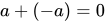
- For each a in R there exists −a in R such that (that is, −a is the additive inverse of a).
- R is a monoid under multiplication, meaning that:
- for all a, b, c in R (that is, ⋅ is associative).
- There is an element 1 in R such that and for all a in R (that is, 1 is the multiplicative identity).[b]
- Multiplication is distributive with respect to addition, meaning that:
- for all a, b, c in R (left distributivity).
- for all a, b, c in R (right distributivity).








Notes on the definition[edit]
In the terminology of this article, a ring is defined to have a multiplicative identity, while a structure with the same axiomatic definition but without the requirement for a multiplicative identity is instead called a rng (IPA: /rʊŋ/). For example, the set of even integers with the usual + and ⋅ is a rng, but not a ring. As explained in § History below, many authors apply the term "ring" without requiring a multiplicative identity.
The multiplication symbol ⋅ is usually omitted; for example, xy means x ⋅ y.
Although ring addition is commutative, ring multiplication is not required to be commutative: ab need not necessarily equal ba. Rings that also satisfy commutativity for multiplication (such as the ring of integers) are called commutative rings. Books on commutative algebra or algebraic geometry often adopt the convention that ring means commutative ring, to simplify terminology.
In a ring, multiplicative inverses are not required to exist. A nonzero commutative ring in which every nonzero element has a multiplicative inverse is called a field.
The additive group of a ring is the underlying set equipped with only the operation of addition. Although the definition requires that the additive group be abelian, this can be inferred from the other ring axioms.[4] The proof makes use of the "1", and does not work in a rng. (For a rng, omitting the axiom of commutativity of addition leaves it inferable from the remaining rng assumptions only for elements that are products: ab + cd = cd + ab.)
Although most modern authors use the term "ring" as defined here, there are a few who use the term to refer to more general structures in which there is no requirement for multiplication to be associative.[5] For these authors, every algebra is a "ring".
Illustration[edit]

The most familiar example of a ring is the set of all integers consisting of the numbers


The axioms of a ring were elaborated as a generalization of familiar properties of addition and multiplication of integers.
Comments
Post a Comment