Quotient ring
Quotient ring[edit]
The notion of quotient ring is analogous to the notion of a quotient group. Given a ring (R, +, ⋅ ) and a two-sided ideal I of (R, +, ⋅ ), view I as subgroup of (R, +); then the quotient ring R/I is the set of cosets of I together with the operations

for all a, b in R. The ring R/I is also called a factor ring.
As with a quotient group, there is a canonical homomorphism p : R → R/I, given by It is surjective and satisfies the following universal property:

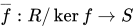
- If f : R → S is a ring homomorphism such that f(I) = 0, then there is a unique homomorphism such that
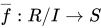

For any ring homomorphism f : R → S, invoking the universal property with I = ker f produces a homomorphism that gives an isomorphism from R/ker f to the image of f.
Module[edit]
The concept of a module over a ring generalizes the concept of a vector space (over a field) by generalizing from multiplication of vectors with elements of a field (scalar multiplication) to multiplication with elements of a ring. More precisely, given a ring R, an R-module M is an abelian group equipped with an operation R × M → M (associating an element of M to every pair of an element of R and an element of M) that satisfies certain axioms. This operation is commonly denoted by juxtaposition and called multiplication. The axioms of modules are the following: for all a, b in R and all x, y in M,
- M is an abelian group under addition.
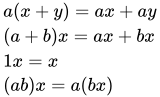
When the ring is noncommutative these axioms define left modules; right modules are defined similarly by writing xa instead of ax. This is not only a change of notation, as the last axiom of right modules (that is x(ab) = (xa)b) becomes (ab)x = b(ax), if left multiplication (by ring elements) is used for a right module.
Basic examples of modules are ideals, including the ring itself.
Although similarly defined, the theory of modules is much more complicated than that of vector space, mainly, because, unlike vector spaces, modules are not characterized (up to an isomorphism) by a single invariant (the dimension of a vector space). In particular, not all modules have a basis.
The axioms of modules imply that (−1)x = −x, where the first minus denotes the additive inverse in the ring and the second minus the additive inverse in the module. Using this and denoting repeated addition by a multiplication by a positive integer allows identifying abelian groups with modules over the ring of integers.
Any ring homomorphism induces a structure of a module: if f : R → S is a ring homomorphism, then S is a left module over R by the multiplication: rs = f(r)s. If R is commutative or if f(R) is contained in the center of S, the ring S is called a R-algebra. In particular, every ring is an algebra over the integers.
Constructions[edit]
Direct product[edit]
Let R and S be rings. Then the product R × S can be equipped with the following natural ring structure:

for all r1, r2 in R and s1, s2 in S. The ring R × S with the above operations of addition and multiplication and the multiplicative identity (1, 1) is called the direct product of R with S. The same construction also works for an arbitrary family of rings: if Ri are rings indexed by a set I, then is a ring with componentwise addition and multiplication.

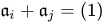
Let R be a commutative ring and be ideals such that whenever i ≠ j. Then the Chinese remainder theorem says there is a canonical ring isomorphism:


A "finite" direct product may also be viewed as a direct sum of ideals.[37] Namely, let be rings, the inclusions with the images (in particular are rings though not subrings). Then are ideals of R and







An important application of an infinite direct product is the construction of a projective limit of rings (see below). Another application is a restricted product of a family of rings (cf. adele ring).
Polynomial ring[edit]
Given a symbol t (called a variable) and a commutative ring R, the set of polynomials
![R[t]=\left\{a_{n}t^{n}+a_{n-1}t^{n-1}+\dots +a_{1}t+a_{0}\mid n\geq 0,a_{j}\in R\right\}](https://wikimedia.org/api/rest_v1/media/math/render/svg/3eebb362f161716c1bcb50a5656fbfbc21532a5d)
forms a commutative ring with the usual addition and multiplication, containing R as a subring. It is called the polynomial ring over R. More generally, the set of all polynomials in variables forms a commutative ring, containing as subrings.
![{\displaystyle R\left[t_{1},\ldots ,t_{n}\right]}](https://wikimedia.org/api/rest_v1/media/math/render/svg/dc4cf3e812fcb5095239260dbc2ba56ceae257e5)

![{\displaystyle R\left[t_{i}\right]}](https://wikimedia.org/api/rest_v1/media/math/render/svg/1e9b4f740e9cf30c4b29d9510608e04a28906ec6)
If R is an integral domain, then R[t] is also an integral domain; its field of fractions is the field of rational functions. If R is a Noetherian ring, then R[t] is a Noetherian ring. If R is a unique factorization domain, then R[t] is a unique factorization domain. Finally, R is a field if and only if R[t] is a principal ideal domain.
Let be commutative rings. Given an element x of S, one can consider the ring homomorphism

![R[t]\to S,\quad f\mapsto f(x)](https://wikimedia.org/api/rest_v1/media/math/render/svg/0226daa10f64386e959d3aadf12fb73e82b45082)
(that is, the substitution). If S = R[t] and x = t, then f(t) = f. Because of this, the polynomial f is often also denoted by f(t). The image of the map is denoted by R[x]; it is the same thing as the subring of S generated by R and x.

Example: denotes the image of the homomorphism
![{\displaystyle k\left[t^{2},t^{3}\right]}](https://wikimedia.org/api/rest_v1/media/math/render/svg/2e4541532126a442f0b3099109c17c60a30b0bb5)
![{\displaystyle k[x,y]\to k[t],\,f\mapsto f\left(t^{2},t^{3}\right).}](https://wikimedia.org/api/rest_v1/media/math/render/svg/70de42b23023914ef0b1a1e71bcff1fdc76af67b)
In other words, it is the subalgebra of k[t] generated by t2 and t3.
Example: let f be a polynomial in one variable, that is, an element in a polynomial ring R. Then f(x + h) is an element in R[h] and f(x + h) – f(x) is divisible by h in that ring. The result of substituting zero to h in (f(x + h) – f(x)) / h is f' (x), the derivative of f at x.
The substitution is a special case of the universal property of a polynomial ring. The property states: given a ring homomorphism and an element x in S there exists a unique ring homomorphism such that and restricts to ϕ.[38] For example, choosing a basis, a symmetric algebra satisfies the universal property and so is a polynomial ring.

![{\overline {\phi }}:R[t]\to S](https://wikimedia.org/api/rest_v1/media/math/render/svg/a9727858171f165d5705e60857e97068df5611bd)


To give an example, let S be the ring of all functions from R to itself; the addition and the multiplication are those of functions. Let x be the identity function. Each r in R defines a constant function, giving rise to the homomorphism R → S. The universal property says that this map extends uniquely to
![R[t]\to S,\quad f\mapsto {\overline {f}}](https://wikimedia.org/api/rest_v1/media/math/render/svg/15eb76de81b0c53d2b82343a721fc4d0cc6f6e29)
(t maps to x) where is the polynomial function defined by f. The resulting map is injective if and only if R is infinite.

Given a non-constant monic polynomial f in R[t], there exists a ring S containing R such that f is a product of linear factors in S[t].[39]
Let k be an algebraically closed field. The Hilbert's Nullstellensatz (theorem of zeros) states that there is a natural one-to-one correspondence between the set of all prime ideals in and the set of closed subvarieties of kn. In particular, many local problems in algebraic geometry may be attacked through the study of the generators of an ideal in a polynomial ring. (cf. Gröbner basis.)
![{\displaystyle k\left[t_{1},\ldots ,t_{n}\right]}](https://wikimedia.org/api/rest_v1/media/math/render/svg/627d900f3df1fb1ea626778cc817791536cad857)
There are some other related constructions. A formal power series ring consists of formal power series
![R[\![t]\!]](https://wikimedia.org/api/rest_v1/media/math/render/svg/3b0ed61bc4efa03186f6fadccd730eb17bc9e0c5)

together with multiplication and addition that mimic those for convergent series. It contains R[t] as a subring. A formal power series ring does not have the universal property of a polynomial ring; a series may not converge after a substitution. The important advantage of a formal power series ring over a polynomial ring is that it is local (in fact, complete).
Matrix ring and endomorphism ring[edit]
Let R be a ring (not necessarily commutative). The set of all square matrices of size n with entries in R forms a ring with the entry-wise addition and the usual matrix multiplication. It is called the matrix ring and is denoted by Mn(R). Given a right R-module U, the set of all R-linear maps from U to itself forms a ring with addition that is of function and multiplication that is of composition of functions; it is called the endomorphism ring of U and is denoted by EndR(U).
As in linear algebra, a matrix ring may be canonically interpreted as an endomorphism ring: This is a special case of the following fact: If is an R-linear map, then f may be written as a matrix with entries fij in S = EndR(U), resulting in the ring isomorphism:



Any ring homomorphism R → S induces Mn(R) → Mn(S).[40]
Schur's lemma says that if U is a simple right R-module, then EndR(U) is a division ring.[41] If is a direct sum of mi-copies of simple R-modules then
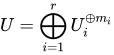

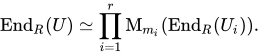
The Artin–Wedderburn theorem states any semisimple ring (cf. below) is of this form.
A ring R and the matrix ring Mn(R) over it are Morita equivalent: the category of right modules of R is equivalent to the category of right modules over Mn(R).[40] In particular, two-sided ideals in R correspond in one-to-one to two-sided ideals in Mn(R).
Limits and colimits of rings[edit]
Let Ri be a sequence of rings such that Ri is a subring of Ri + 1 for all i. Then the union (or filtered colimit) of Ri is the ring defined as follows: it is the disjoint union of all Ri's modulo the equivalence relation x ~ y if and only if x = y in Ri for sufficiently large i.

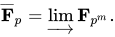
Examples of colimits:
- A polynomial ring in infinitely many variables:
- The algebraic closure of finite fields of the same characteristic
- The field of formal Laurent series over a field k: (it is the field of fractions of the formal power series ring )
- The function field of an algebraic variety over a field k is where the limit runs over all the coordinate rings k[U] of nonempty open subsets U (more succinctly it is the stalk of the structure sheaf at the generic point.)
![R[t_{1},t_{2},\cdots ]=\varinjlim R[t_{1},t_{2},\cdots ,t_{m}].](https://wikimedia.org/api/rest_v1/media/math/render/svg/0c562ae4e64063e5aedc587c8442c596aed80eb0)
![k(\!(t)\!)=\varinjlim t^{-m}k[\![t]\!]](https://wikimedia.org/api/rest_v1/media/math/render/svg/536bed6a210e67bcc910b2055075b9afa8306105)
![{\displaystyle k[\![t]\!].}](https://wikimedia.org/api/rest_v1/media/math/render/svg/db5e2887e456f95fb545b62435a54ac319e7a782)
![\varinjlim k[U]](https://wikimedia.org/api/rest_v1/media/math/render/svg/fc7735d64bbdf3d5a25544d60bea11fdd0a5f54e)
Any commutative ring is the colimit of finitely generated subrings.
A projective limit (or a filtered limit) of rings is defined as follows. Suppose we're given a family of rings Ri, i running over positive integers, say, and ring homomorphisms Rj → Ri, j ≥ i such that Ri → Ri are all the identities and Rk → Rj → Ri is Rk → Ri whenever k ≥ j ≥ i. Then is the subring of consisting of (xn) such that xj maps to xi under Rj → Ri, j ≥ i.


For an example of a projective limit, see § Completion.
Localization[edit]
The localization generalizes the construction of the field of fractions of an integral domain to an arbitrary ring and modules. Given a (not necessarily commutative) ring R and a subset S of R, there exists a ring together with the ring homomorphism that "inverts" S; that is, the homomorphism maps elements in S to unit elements in and, moreover, any ring homomorphism from R that "inverts" S uniquely factors through [42] The ring is called the localization of R with respect to S. For example, if R is a commutative ring and f an element in R, then the localization consists of elements of the form (to be precise, )[43]
![R[S^{-1}]](https://wikimedia.org/api/rest_v1/media/math/render/svg/cc8e9aca12e1c82bcb76786e721b503057d121bb)
![{\displaystyle R\to R\left[S^{-1}\right]}](https://wikimedia.org/api/rest_v1/media/math/render/svg/4ff24251e09611253a5e59710f41fef5e9ea8295)
![{\displaystyle R\left[S^{-1}\right],}](https://wikimedia.org/api/rest_v1/media/math/render/svg/dc5da3880f2a84e3c59d744d4a6a70c91648127f)
![{\displaystyle R\left[S^{-1}\right].}](https://wikimedia.org/api/rest_v1/media/math/render/svg/477d928832e71936d39c6e196a1ec4c7f9c5f003)
![{\displaystyle R\left[S^{-1}\right]}](https://wikimedia.org/api/rest_v1/media/math/render/svg/5a2fa5e7650f1b84116f5dd0986162ed090cafea)
![{\displaystyle R\left[f^{-1}\right]}](https://wikimedia.org/api/rest_v1/media/math/render/svg/866a1856d4f363ae6d4d2f3818ff980b72442c51)

![{\displaystyle R\left[f^{-1}\right]=R[t]/(tf-1).}](https://wikimedia.org/api/rest_v1/media/math/render/svg/751001e38a83d034e0cf683b63cf45ac724151ad)
The localization is frequently applied to a commutative ring R with respect to the complement of a prime ideal (or a union of prime ideals) in R. In that case one often writes for is then a local ring with the maximal ideal This is the reason for the terminology "localization". The field of fractions of an integral domain R is the localization of R at the prime ideal zero. If is a prime ideal of a commutative ring R, then the field of fractions of is the same as the residue field of the local ring and is denoted by


If M is a left R-module, then the localization of M with respect to S is given by a change of rings
![{\displaystyle M\left[S^{-1}\right]=R\left[S^{-1}\right]\otimes _{R}M.}](https://wikimedia.org/api/rest_v1/media/math/render/svg/182e09cf0feec2967d8337e197459da4d0084bde)
The most important properties of localization are the following: when R is a commutative ring and S a multiplicatively closed subset
- is a bijection between the set of all prime ideals in R disjoint from S and the set of all prime ideals in [44]
- f running over elements in S with partial ordering given by divisibility.[45]
- The localization is exact:is exact over whenever is exact over R.
- Conversely, if is exact for any maximal ideal then is exact.
- A remark: localization is no help in proving a global existence. One instance of this is that if two modules are isomorphic at all prime ideals, it does not follow that they are isomorphic. (One way to explain this is that the localization allows one to view a module as a sheaf over prime ideals and a sheaf is inherently a local notion.)
![{\displaystyle {\mathfrak {p}}\mapsto {\mathfrak {p}}\left[S^{-1}\right]}](https://wikimedia.org/api/rest_v1/media/math/render/svg/5dc99eed581db91f5f4d659076ee275ba9728331)
![{\displaystyle R\left[S^{-1}\right]=\varinjlim R\left[f^{-1}\right],}](https://wikimedia.org/api/rest_v1/media/math/render/svg/a32ebca63604a2aebf74c48d3b5f3935c419df84)
![{\displaystyle 0\to M'\left[S^{-1}\right]\to M\left[S^{-1}\right]\to M''\left[S^{-1}\right]\to 0}](https://wikimedia.org/api/rest_v1/media/math/render/svg/645fb810cb3b83f73d5257efcb9871cde5ddd25a)



In category theory, a localization of a category amounts to making some morphisms isomorphisms. An element in a commutative ring R may be thought of as an endomorphism of any R-module. Thus, categorically, a localization of R with respect to a subset S of R is a functor from the category of R-modules to itself that sends elements of S viewed as endomorphisms to automorphisms and is universal with respect to this property. (Of course, R then maps to and R-modules map to -modules.)
Comments
Post a Comment